 ShopNx
How to price jewellery from the gold rate, wastage and making charge
Price each piece from today’s rate, not last week’s. Multiply the rate for its purity by the weight, add wastage, the making charge and stones, then 3% GST on the whole. A price left on an old rate gives money away: in the example below, a ₹500 a gram rise costs ₹6,000 on a single 10 gram ring.
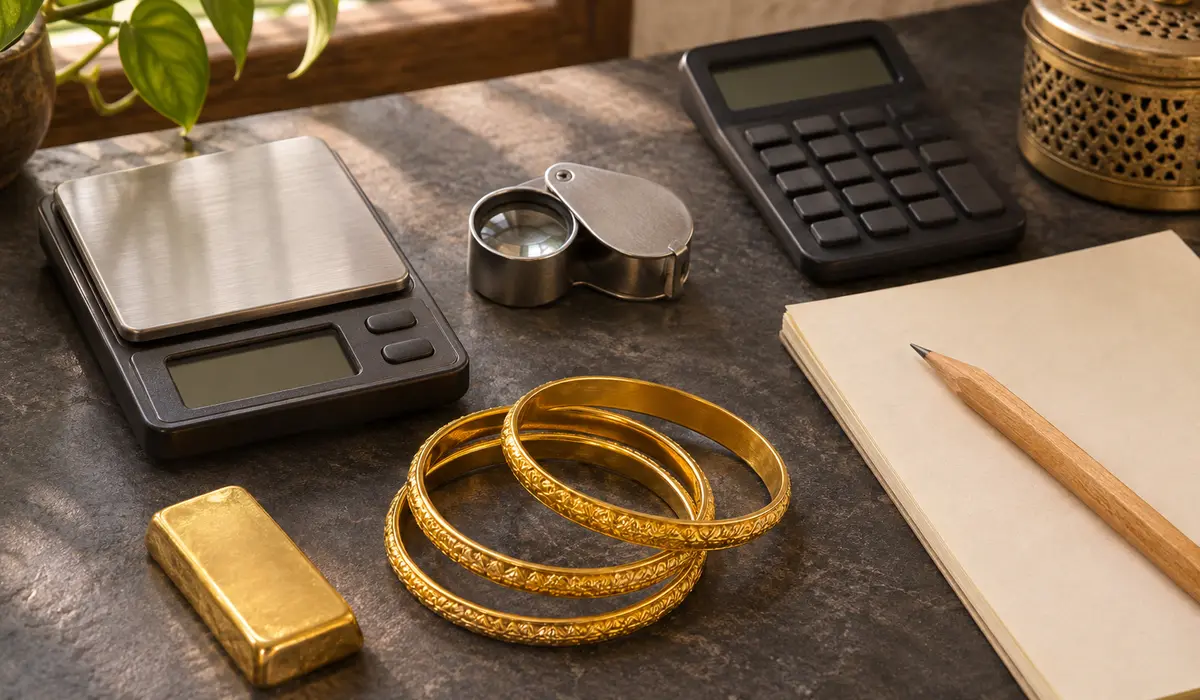
What goes into a gold jewellery price?
- Metal. The day’s rate for the purity × the weight in grams.
- Wastage. The gold lost while melting, cutting and shaping, as a percent of the metal.
- Making charge. The work, as a percent of the metal or a fixed amount per gram.
- Stones. Their own value, priced separately.
- Hallmarking. ₹75 per gold piece and ₹35 per silver piece at a BIS centre, plus tax.
- GST. 3% of the full value, making charge included.
Purity sets the rate. 22K gold is 91.6% pure, so it is sold as 916; 18K is 75% (750) and 14K is 58.5% (585). IBJA publishes a rate for each of these on working days, per 10 grams, without GST and making charges.
How much to charge for wastage and making is your call. Published guides give wide ranges: CaratLane puts each at about 6% to 14%, and BankBazaar puts making at 3% to 25%, more for detailed bridal work.
How do you price a 22K ring, step by step?
Take an example ring, not a real product: 10 grams of 22K gold, 8% wastage, a 12% making charge on the metal, and no stones. The rate is IBJA’s 916 rate for the afternoon of 19 November 2026, ₹1,18,650 per 10 grams.
| Part of the price | Amount |
|---|---|
| Metal: 10 g × ₹11,865 a gram | ₹1,18,650 |
| Wastage: 8% of the metal | ₹9,492 |
| Making charge: 12% of the metal | ₹14,238 |
| Before GST | ₹1,42,380 |
| GST: 3% of the full value | ₹4,271 |
| Price to the buyer | ₹1,46,651 |
Add ₹75 plus tax for hallmarking, shown on the bill as its own line.
What does an old rate cost you?
Gold moves every day, and wastage and making move with it because they are percents of the metal. Say the rate rises by an example ₹500 a gram while your listing still shows the old price. On the ring above you lose 10 g × ₹500 on the metal, plus 20% of that in wastage and making: ₹6,000 before GST, on one piece.
- Reprice every working day, from one rate source, before you share links on WhatsApp.
- Give a quote a time limit. “Price valid today” protects you when a buyer replies tomorrow.
- Keep each purity separate. A 22K rate on an 18K piece overcharges; an 18K rate on 22K undercharges.

In ShopNx you give each design its weight, wastage, making charge and stones once. When you type the day’s rate and save, every design on that metal is repriced and rounded to a whole rupee. ShopNx doesn’t fetch the rate for you, so the rate you sell at stays your decision (how to set up metal rates).
How do big jewellery brands show their prices online?
| Company | What it sells | What the buyer sees | How it takes orders |
|---|---|---|---|
| BlueStone | Gold, platinum, diamond and gemstone jewellery | A full breakup on the product page: metal, diamond, making charge and GST | Online checkout and video calls |
| CaratLane | Gold and diamond jewellery | One total, marked inclusive of all taxes | Online checkout, free try at home for up to five designs, video calls and store visits |
| Candere | Gold and diamond jewellery, online partner of the Kalyan group | A price breakup tab that lists the making charge and its discount | Online checkout, cash on delivery by pincode, video calls and store pickup |
| PC Jeweller | Gold, diamond and silver jewellery | A published buyback policy: 97% of the current gold value on gold jewellery | Online, store appointments, phone and WhatsApp |
As seen on each company’s own pages on 20 November 2026.
What can a small seller offer that builds trust?
- A breakup on every piece. Weight, purity, wastage, making and GST, in the description.
- The hallmark and HUID in a close-up photo, so the buyer can check the piece.
- A short video of the piece on a scale, sent on WhatsApp before payment.
- Buyback terms in writing. Say what percent of the gold value you return and that making and GST are not refunded, if that is your rule.
How do you launch a jewellery store for free this week?
- Create your store. ShopNx is free: no monthly fee and no fee on your sales.
- Add a rate for each metal and purity, such as Gold 22K, Gold 18K and silver.
- Add your designs with weight, wastage, making charge and stones, or upload them as a spreadsheet.
- Set GST for the category at the rate your accountant confirms.
- Connect payments and decide whether to offer cash on delivery on gold.
- Type the rate each working day. Your whole catalogue follows it.
What the store doesn’t cover still costs money: gateway fees, hallmarking, insured shipping and your stock. See what a jewellery store costs to run online and ShopNx for jewellery.
How do you get the first orders without ads?
Start with buyers who already know you. Share one design a day on WhatsApp with today’s price and its breakup, and put your store link in your Instagram bio. A price that matches the day’s rate, and shows how it was worked out, answers the first question most buyers ask.
What should you never promise?
- Never call a charge “free” or “zero” if it is added back elsewhere in the price.
- Never add GST or other charges only at the last step. Show the full price up front.
- Never write “hallmarked” on a piece without a BIS hallmark and HUID.
- Never promise a buyback percent you can’t pay on every piece.
Rates, charges and rules here are the ones published in November 2026, and they change. Check today’s rate before you price, and confirm tax questions with a chartered accountant.
Questions sellers ask
How is the price of gold jewellery calculated in India?
Take the day’s gold rate for the purity, multiply by the weight in grams, then add wastage, the making charge, any stones and the hallmarking charge. GST of 3% is charged on the full value, making charge included.
What is the difference between wastage and making charge?
Wastage covers the gold lost while melting, cutting and shaping a piece. The making charge pays for the work. Both are usually a percent of the metal value, and the making charge can also be a fixed amount per gram.
Which gold rate should a small jeweller use?
Many jewellers follow the IBJA rate or their local association’s board rate. IBJA publishes 999, 995, 916, 750 and 585 gold rates on working days, per 10 grams, without GST and making charges. Use one source every day and say which one on your store.
Is GST on making charges different from GST on gold?
When you sell finished jewellery, GST is 3% of the total value whether or not the making charge is shown separately. Job work done for another jeweller is taxed differently, so confirm your case with a chartered accountant.
Do I have to show the hallmarking charge on the bill?
Yes. BIS asks for the bill to show each article’s net weight, its purity in carat and fineness, and the hallmarking charge. As of November 2026 a centre charges ₹75 per gold article and ₹35 per silver article, plus tax.